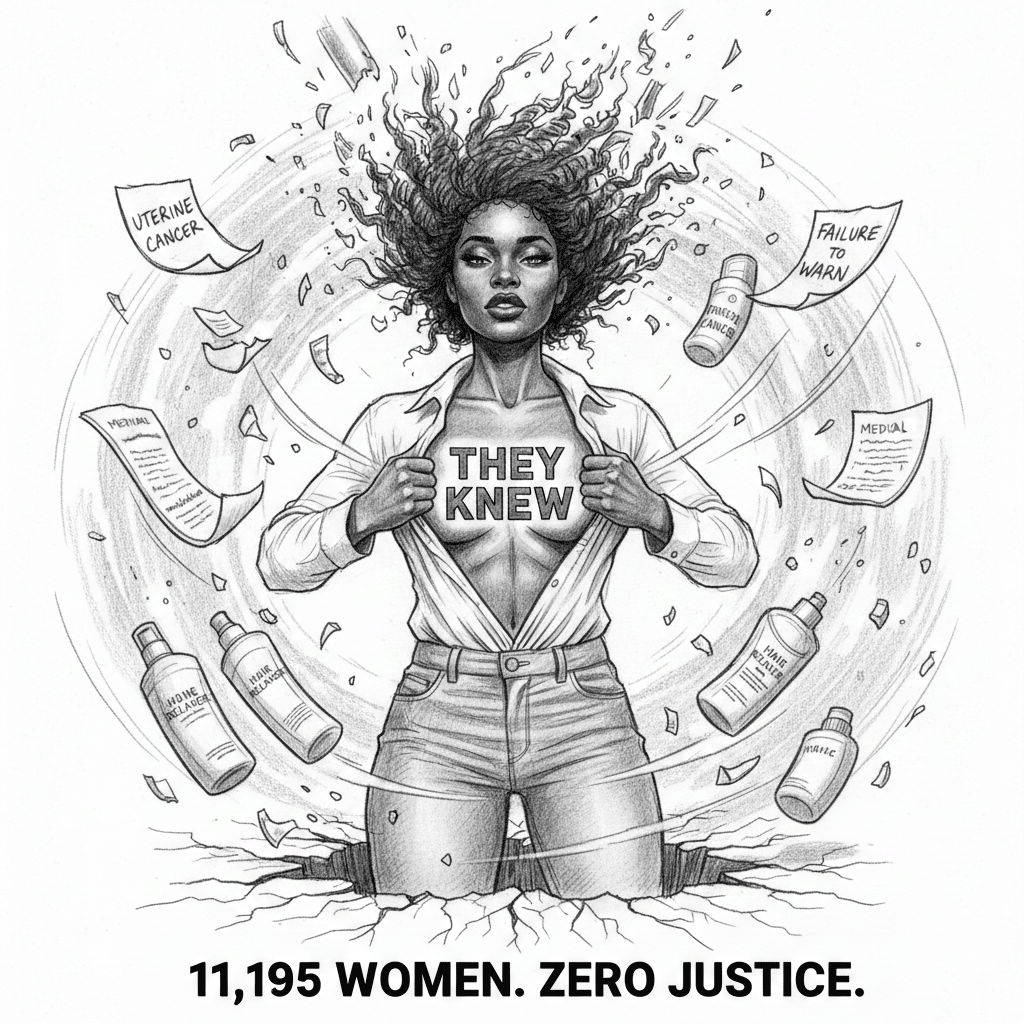
Hair relaxer litigation is an active mass tort in 2026 involving 8,000+ plaintiffs alleging uterine cancer causation, consolidated under MDL 3060 with bellwether trials scheduled for late 2025–2026. The 2022 NIH Sister Study established epidemiological causation, shifting settlement dynamics in plaintiff’s favor. With case intake still open and trial verdicts pending, early enrollment creates competitive advantage for plaintiff firms before damages expectations reset based on bellwether outcomes.
We’ve managed $250M+ in Facebook ad spend across 600+ plaintiff law firms and 100+ mass torts over 15 years. Hair relaxer litigation is different: it’s nationwide, it’s underserved, and early case intake is everything before bellwether results hit in late 2025 or 2026. This post breaks down the legal landscape, claimant criteria, advertising opportunity, and why now is the moment to act.
Why Hair Relaxer Litigation Matters Right Now in 2026
Chemical hair relaxers have been used for decades, predominantly by Black women in the U.S. The products contain endocrine-disrupting chemicals (EDCs)—parabens, bisphenol-A, formaldehyde, phthalates—that mimic estrogen and disrupt hormonal pathways. In 2022, the NIH published the Chang et al. study in JNCI, showing a 2.55x increased risk of uterine cancer in frequent hair relaxer users. That study became the science backbone of MDL 3060.
Here’s the timing advantage: MDL 3060 is in active discovery with bellwether selection projected to conclude in 2025, with first trials in late 2025 or 2026. No verdicts have landed yet. No settlements have reset expectations. This means claimant acquisition costs are still low, and the case profile is still strong. Defendants (L’Oréal, Revlon, SoftSheen-Carson, and others) have significant liability exposure, but the litigation is young enough that CPL hasn’t inflated.
The plaintiff population is also underserved. Black women disproportionately used chemical relaxers, often starting in childhood. Early exposure + decades of use = compelling injury narratives and strong damages arguments. If your firm hasn’t begun building a hair relaxer lawsuit uterine cancer 2026 intake pipeline, this is the moment.
Legal Landscape: MDL 3060, Bellwether Selection, and Settlement Outlook
MDL 3060 is centralized in the Northern District of Illinois before Judge Mary Rowland. The MDL was formed in 2023 and is currently in the discovery phase. Three major defendants anchor the litigation: L’Oréal USA (Dark & Lovely, Mizani), Revlon (Creme of Nature, Realistic), and SoftSheen-Carson, which is an L’Oréal subsidiary. Additional manufacturers like Godrej (Just For Me, Africa’s Best) are named as defendants.
As of late 2025, the MDL has 8,000+ enrolled plaintiffs. Bellwether selection is underway. These bellwether cases will be tried first and are expected to conclude in late 2025 or early 2026. The outcomes of these trials will dictate settlement dynamics. Until those verdicts land, there is no meaningful settlement framework in place.
This creates a unique advantage for plaintiff firms entering now: low CPL, strong science, and pre-verdict momentum. Once bellwether wins hit, both CPL and case valuations will adjust. Firms that have built robust intake pipelines before bellwether conclusions will have negotiating leverage and volume.
The science is robust. The NIH Sister Study tracked 33,000 women and found that frequent hair relaxer users had a 2.05x to 2.55x increased risk of uterine cancer, depending on frequency and duration of use. The mechanism is well-established: EDCs disrupt estrogen signaling and promote endometrial proliferation. Defense arguments will focus on confounders and alternative causation, but the NIH study is peer-reviewed, epidemiologically sound, and reproducible.
Revlon’s bankruptcy complicates recovery strategy but does not eliminate the claim. L’Oréal has deep pockets and faces significant reputational risk given the disproportionate impact on Black women—a community with heightened awareness of product safety issues.
Who Qualifies: Claimant Criteria and Injury Profile
The core eligibility criteria for the hair relaxer lawsuit uterine cancer 2026 are straightforward but must be carefully screened:
- Product Use: Regular use of chemical hair relaxers (not natural relaxers or temporary treatments) for a minimum of 4+ years. Longer duration and earlier age of first use strengthen the case.
- Timing of Exposure: First use before age 18 is ideal, as early exposure and cumulative dose over decades increases causation credibility.
- Injury Type: Diagnosed uterine cancer (endometrial cancer or leiomyosarcoma). Uterine fibroids requiring surgery are also viable but somewhat weaker than cancer claims.
- Demographics: Black/African American women have the strongest case profile due to higher use rates, earlier initiation, and the NIH study’s focus on this population.
- Statute of Limitations: Varies by state (typically 2-5 years from diagnosis or discovery of causation). Your intake team must verify SOL status for each prospect.
The ideal claimant profile: Black woman, age 35-65, diagnosed with uterine cancer or leiomyosarcoma, began using relaxers in childhood or teens, used consistently for 15+ years. These claimants carry the strongest damages narrative and align most closely with the NIH Sister Study cohort.
Secondary claimants may include women with uterine fibroids requiring hysterectomy or myomectomy (fibroid removal surgery), though cancer claims command higher valuations. Men who were exposed in family settings are not excluded, but they represent a tiny fraction of the claimant population.
Advertising Opportunity: Claimant Pool Size and CPL Outlook
The addressable claimant pool is substantial. According to market research, approximately 60-80% of Black women in the U.S. have used chemical hair relaxers at some point. The uterine cancer incidence rate among Black women is approximately 20-25 per 100,000 per year (higher than white women). This translates to a potential national claimant pool of 50,000-100,000 women with viable claims, particularly if fibroid cases are included.
Currently, with 8,000+ enrolled in the MDL, penetration is still low. This is the acquisition window.
Cost per lead (CPL) for hair relaxer litigation remains favorable—typically $50-$120 per qualified lead on Facebook, depending on geographic targeting and audience overlap with other mass tort campaigns. In some high-competition mass torts, CPL has risen to $150-$250 per lead. Hair relaxer CPL remains reasonable because:
- The litigation is still pre-bellwether. Plaintiffs aren’t yet motivated by trial outcomes they’ve seen.
- The plaintiff population (Black women, often 40+) is not as saturated with mass tort advertising as, say, Ozempic or talc claimants.
- Geographic targeting can be refined to communities with highest relaxer use and highest uterine cancer incidence.
From an advertising strategy perspective, Facebook targeting should focus on:
- Demographic Targeting: Black/African American women, ages 35-70, United States.
- Geographic Layering: Highest concentrations in Southeast (Georgia, North Carolina, South Carolina, Louisiana), Midwest (Illinois, Ohio, Michigan), and Northeast urban areas (New York, Pennsylvania, New Jersey).
- Interest/Behavior Targeting: Hair care, natural hair movement, women’s health, uterine cancer awareness groups.
- Lookalike Audiences: Built from prior mass tort conversion data if available.
- Retargeting: Website visitors who land on your intake pages but don’t immediately convert.
Creative messaging should emphasize the NIH study findings, the 2.55x risk multiplier, and the fact that this is an active MDL with real litigation momentum—not speculative. Testimonial videos from enrolled plaintiffs (with proper consent) are powerful. Messaging should also directly address the demographic: “If you used relaxers for years and were diagnosed with uterine cancer, you may have a claim.”
What MTAA Delivers: Full-Funnel Campaign Management for Hair Relaxer Litigation
At Mass Tort Ad Agency, we’ve built 600+ law firm relationships and managed $250M+ in Facebook spend across 100+ mass torts. Hair relaxer litigation is exactly the kind of campaign we excel at: strong science, underserved population, tight targeting, and a 12-18 month window before case valuations shift.
Here’s what full campaign management for the hair relaxer lawsuit uterine cancer 2026 litigation includes:
- Audience Segmentation: We build granular lookalike and interest-based audiences to isolate high-intent claimants. We layer geographic data, demographic filters, and behavioral signals to suppress low-quality leads and reduce CPL.
- Creative Development: Multi-variant testing of landing page copy, video testimonials, educational graphics explaining the NIH study, and direct response ad copy. We A/B test messaging around cancer diagnosis, fibroid surgery, product use duration, and age of first exposure.
- Landing Page Optimization: Custom intake funnels designed for hair relaxer claimants. Forms collect product use history, diagnosis date, medical documentation status, and statute of limitations info. Conversion-optimized for both mobile and desktop.
- Retargeting and Sequential Messaging: Once a prospect lands on your site, we deploy a 30-90 day retargeting sequence to re-engage visitors who don’t immediately convert. Sequential messaging emphasizes case strength, MDL momentum, and time sensitivity.
- Cost-Plus Pricing: We charge transparent, cost-plus pricing: your ad spend (Facebook CPM, CPC, CPL) plus a flat 15% agency fee. No hidden charges. You see all spend data in real-time. For a typical hair relaxer campaign targeting the U.S., expect $8,000-$25,000 monthly spend depending on your volume goals and geographic focus.
- Real-Time Performance Tracking: Weekly reporting on CPL, cost per qualified lead, intake form completion rates, and assisted conversions. We optimize campaigns mid-flight, pause underperforming audiences, and scale winners.
- Case Management Integration: We work with your intake team to ensure lead quality. Feedback loop: if certain traffic sources yield poor-quality leads, we adjust targeting immediately.
- Competitor Monitoring: We track other law firm campaigns in this space to identify white space and avoid bidding wars on saturated keywords.
The advantage of partnering with MTAA for hair relaxer litigation is straightforward: you get expert audience targeting, proven creative frameworks from 100+ torts, transparent pricing, and real-time optimization. We don’t promise miracles—we deliver disciplined, data-driven campaign management that lowers CPL and maximizes intake volume at scale.
The Window is Now: Why 2025-2026 is the Critical Intake Period
Bellwether trials are projected for late 2025 and early 2026. Once verdicts land, the litigation landscape will shift dramatically. If plaintiffs win and verdicts are substantial, CPL will rise as competition for claimants increases. If verdicts disappoint, CPL may remain stable, but case valuations will drop—which impacts your firm’s profitability on this docket.
The best strategy is to build intake volume now, before bellwether outcomes become public. Firms with 200-500 enrolled claimants before bellwether verdicts will have significant leverage in settlement negotiations and will have locked in lower acquisition costs. Firms trying to ramp up after bellwether wins will face higher CPL and tighter margins.
Additionally, statute of limitations is a real constraint. Many claimants diagnosed with uterine cancer in 2018-2022 are approaching the end of their SOL window (typically 2-5 years from diagnosis, depending on state discovery rule). If a woman was diagnosed in 2020 and her state has a 3-year SOL, she may be time-barred by late 2025. Early intake captures this population.
Next Steps: Consult MTAA on Your Hair Relaxer Campaign Strategy
If your firm is considering or already running a hair relaxer lawsuit uterine cancer 2026 campaign, or if you’re exploring mass tort advertising for the first time, let’s talk. We’ll assess your current intake volume, review your targeting strategy, and propose a campaign roadmap aligned with your firm’s scale and profitability targets.
Here’s what a consultation includes: audit of your current digital presence and any existing hair relaxer campaigns, competitive analysis of other law firms’ creative and messaging, audience segmentation recommendations specific to your geographic footprint, and a transparent cost estimate for a 90-day pilot campaign.
We’ve managed campaigns for boutique firms with 50 claimants and national firms with 10,000+. We work at your pace and with full transparency on spend and performance. If hair relaxer litigation is part of your 2025-2026 strategy, the hair relaxer lawsuit uterine cancer 2026 docket is live, the science is strong, and the claimant pool is deep. Don’t leave intake on the table.
Contact Mass Tort Ad Agency today for a no-cost, no-obligation consultation on building your hair relaxer intake pipeline. With 15+ years of mass tort advertising experience, $250M+ in managed spend, and 600+ satisfied law firm clients, we know how to turn targeted advertising into qualified claimant intake at scale. Let’s build your case portfolio before bellwether verdicts reshape the market.
Frequently Asked Questions: Hair Relaxer Lawsuits
What are the eligibility criteria for hair relaxer uterine cancer claims in MDL 3060?
Claimants typically must demonstrate regular or frequent use of chemical hair relaxers over an extended period, a diagnosis of uterine cancer, and exposure predominantly before their cancer diagnosis. Medical records documenting the uterine cancer diagnosis and product usage history are critical to establishing a compensable claim, though specific date thresholds and frequency requirements are being refined as MDL 3060 progresses.
What is the current status of MDL 3060 and when will bellwether trials occur?
MDL 3060 is actively in discovery phase with bellwether selection projected to conclude in 2025, and first trials expected to begin in late 2025 or 2026. The litigation currently has over 8,000 plaintiffs enrolled, and early verdicts will significantly influence future settlement valuations and case strategy across the entire docket.
How strong is the scientific causation evidence for hair relaxers and uterine cancer?
The 2022 NIH Sister Study (Chang et al., published in JNCI) demonstrated a 2.55x increased risk of uterine cancer in frequent hair relaxer users and serves as the primary scientific foundation for MDL 3060 claims. The study’s peer-reviewed publication and large cohort design provide strong causation support that defendants will have difficulty challenging.
What digital advertising strategy should we use to reach hair relaxer claimants in 2026?
Facebook and digital display campaigns targeting Black women aged 40-65 with keywords around ‘uterine cancer’ and ‘hair relaxer lawsuit’ remain highly effective; our firm has deployed $250M+ in Facebook ad spend across mass torts, and hair relaxer claimants show strong intake conversion when targeted by geography and product-specific messaging. Early-mover firms capturing claimants before bellwether verdicts hit will have substantial first-mover advantage in case volume and settlement positioning.
Which chemical ingredients in hair relaxers are driving the uterine cancer claims?
Endocrine-disrupting chemicals (EDCs) in hair relaxers—including parabens, bisphenol-A (BPA), formaldehyde, and phthalates—are the focus of litigation because they mimic estrogen and disrupt hormonal pathways linked to uterine cancer development. Product formulations and ingredient disclosure will be critical discovery items to establish which defendants’ products contained the highest concentrations of these harmful chemicals.
Ready to Build Your Caseload?
Get a free campaign analysis from Mass Tort Ad Agency.
$250M+ in mass tort Facebook ad spend. 600+ law firms served. Transparent cost-plus pricing with no hidden fees.